
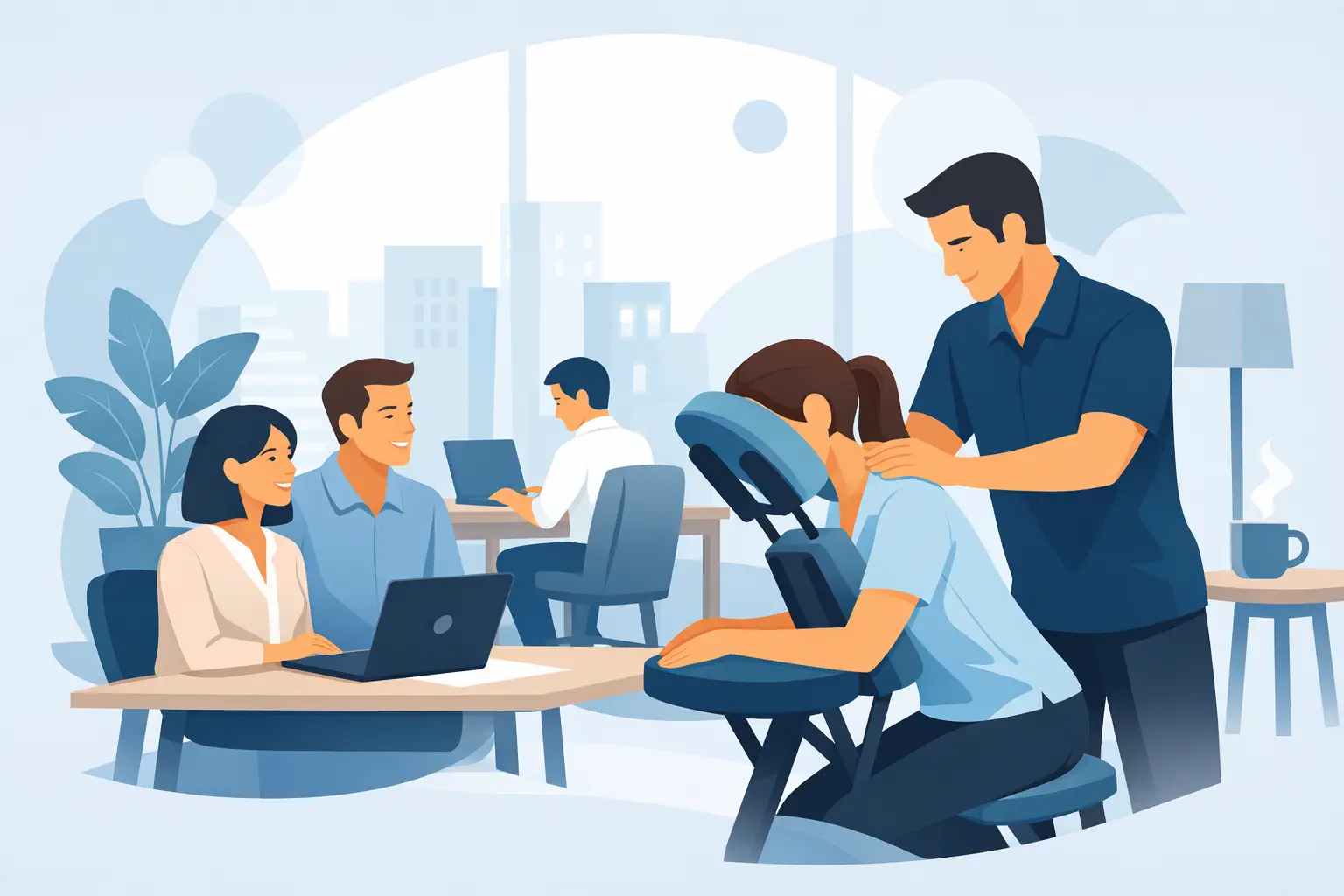
A tense team rarely needs another poster about wellbeing. More often, it needs something practical that fits into a working day without disrupting meetings, targets or client delivery. That is where office chair massage benefits stand out. For desk-based teams, a short, professionally delivered treatment can reduce physical tension, calm stress levels and give employees a genuine reset in the middle of a demanding day.
For employers, that matters because pressure does not stay neatly contained at an individual level. It shows up in concentration dips, shorter tempers, low energy, presenteeism and rising absence. Workplace wellbeing works best when it is easy to access, straightforward to manage and clearly connected to business performance. Chair massage sits in that space very well.
Why office chair massage benefits matter at work
Most office-based employees spend hours sitting, typing, looking at screens and moving very little. Over time, that pattern creates a familiar set of issues – tight shoulders, neck stiffness, headaches, lower mood, eye strain and mental fatigue. Even highly engaged teams can start to feel worn down when the working week becomes a cycle of deadlines, back-to-back calls and poor posture.
Chair massage is designed for exactly this kind of environment. Treatments are typically short, effective and delivered with employees fully clothed, using a specialist chair that supports the upper body comfortably. That means there is very little set-up, no need for changing facilities and no complicated logistics for the employer.
The real value is that the intervention matches the problem. Office tension is often localised in the back, neck, shoulders, arms and scalp, and these areas respond well to targeted massage. At the same time, the simple act of pausing for ten or fifteen minutes can interrupt stress patterns before they become entrenched.
The business case behind office chair massage benefits
Wellbeing initiatives are more likely to earn internal support when they are clearly linked to outcomes leaders care about. Chair massage is not a cure-all, and no responsible provider should present it as one. But it can make a meaningful contribution to a healthier, more productive workplace when used as part of a wider employee wellbeing approach.
The first business benefit is stress reduction. Stress affects judgement, communication and resilience. A calmer employee is often a more focused and constructive one, particularly in fast-moving office settings where people are expected to switch quickly between tasks.
The second is productivity. This is not about claiming that ten minutes of massage suddenly transforms output across an entire department. It is more realistic than that. Employees who feel less tense and mentally overloaded often return to their desks with better concentration and more energy for the next block of work. Across a team, those small improvements can add up.
The third is culture. When employers provide wellbeing support that staff actually want to use, it sends a strong signal. It shows care in a practical form rather than in broad statements. That can support morale, help employees feel valued and reinforce a workplace culture where wellbeing is treated seriously.
Retention also enters the picture. People do not stay with an employer purely because of one perk, but they do notice whether the business makes day-to-day work more sustainable. In competitive hiring markets, visible wellbeing support can strengthen employer brand and improve the overall employee experience.
Physical benefits employees notice quickly
The most immediate office chair massage benefits are usually physical. Many employees feel relief in the neck, shoulders and upper back after a single session, especially if they spend long stretches at a laptop or desktop. These are common pressure points in office environments, and they tend to tighten gradually until discomfort becomes normalised.
Massage can help release muscular tension, improve circulation and encourage the body to shift out of a stress response. For someone who has spent the morning hunched over a keyboard or sitting through a sequence of calls, that relief can be significant.
Some employees also report fewer tension headaches, less jaw clenching and greater ease of movement afterwards. It depends on the individual, the intensity of their workload and any pre-existing conditions, but the general pattern is consistent: when physical strain is reduced, people often feel more comfortable and capable at work.
This is particularly relevant in offices where posture problems and repetitive strain are common. Chair massage should not replace ergonomic assessments or sensible workstation set-up. It works better as a complementary measure that helps manage the physical effects of desk-based work.
Mental reset, focus and emotional wellbeing
Physical relief is only part of the picture. A well-run chair massage session often gives employees something they struggle to create on their own during a busy day – a genuine pause. Not checking emails, not answering messages, not preparing for the next meeting. Just a short period where the nervous system has a chance to settle.
That reset can improve focus afterwards. Employees often describe feeling clearer, lighter and less mentally cluttered. For teams dealing with sustained cognitive load, that is valuable. Modern office work is not only physically static; it is mentally noisy. Interruptions are constant, and many employees move through the day without any real recovery time.
There is also a morale effect. When people feel looked after, they are more likely to feel positive about their workplace. That does not mean every wellbeing initiative needs to be elaborate. In many cases, simple, high-quality interventions have the strongest uptake because they are accessible and immediately useful.
Why chair massage works well for employers
From an operational point of view, chair massage is one of the more practical workplace wellbeing services to implement. It can be delivered in a small meeting room or quiet office space, with minimal interruption and no major planning burden. For busy HR teams and office managers, that matters.
It is also flexible. Some employers use chair massage as part of a one-off wellbeing day, a staff appreciation event or a mental health awareness campaign. Others bring it in on a recurring basis as part of an ongoing wellbeing programme. The right model depends on headcount, budget, office attendance patterns and the business objective.
A one-off event can create visibility and goodwill quickly. A regular programme usually has stronger long-term value because employees come to expect and trust the service. Repeat sessions can also help reinforce healthy habits around taking breaks and managing stress before it escalates.
Another practical advantage is broad appeal. Unlike some wellbeing initiatives that attract only a narrow group of employees, chair massage tends to have wide relevance across office populations. It is easy to understand, easy to access and suitable for many desk-based roles.
What results should employers realistically expect?
The strongest wellbeing programmes are measured with a clear head. Chair massage can support reduced stress, improved morale and better day-to-day comfort, but expectations should remain grounded. It is not a substitute for workload management, good leadership or healthy workplace policies.
What employers can reasonably expect is strong engagement when the service is communicated well and delivered professionally. They can also expect positive employee feedback, visible appreciation and a meaningful contribution to the broader wellbeing agenda. In some organisations, it may help reduce the low-level strain that leads to disengagement or short-term absence.
The quality of delivery makes a difference. Qualified, insured therapists who understand workplace environments are essential. So is a provider that can deliver reliably across locations, manage bookings efficiently and tailor the service to the organisation rather than forcing a one-size-fits-all format. That is where experience matters, particularly for businesses running programmes across multiple offices or trying to standardise employee wellbeing support.
Making chair massage part of a smarter wellbeing strategy
The best results usually come when chair massage is positioned not as a novelty, but as part of a deliberate effort to support employee performance and wellbeing. That means thinking about timing, communication and consistency.
For example, periods of peak pressure such as quarterly deadlines, organisational change, office move-ins or busy seasonal cycles can be ideal moments to introduce massage support. Equally, regular monthly or fortnightly sessions can help maintain momentum and show employees that wellbeing is an ongoing commitment.
It also helps to frame the offer properly. When employers present chair massage as a practical way to reduce stress, support posture-related discomfort and improve the working day, uptake is often stronger than when it is treated as a vague perk. Employees respond well when the purpose is clear.
For businesses that want workplace wellbeing to be easy to run and credible in front of senior stakeholders, service quality is just as important as the treatment itself. Providers such as Therapy Bookings focus on making delivery simple for employers while ensuring therapists are qualified, professional and experienced in corporate settings.
A good wellbeing initiative should feel useful, not decorative. Chair massage earns its place because it meets employees where they are – at their desks, under pressure, and often carrying more tension than they realise. When support is practical, visible and easy to access, people use it. And when people use it, employers have a better chance of building a workplace that feels healthier, steadier and more sustainable.