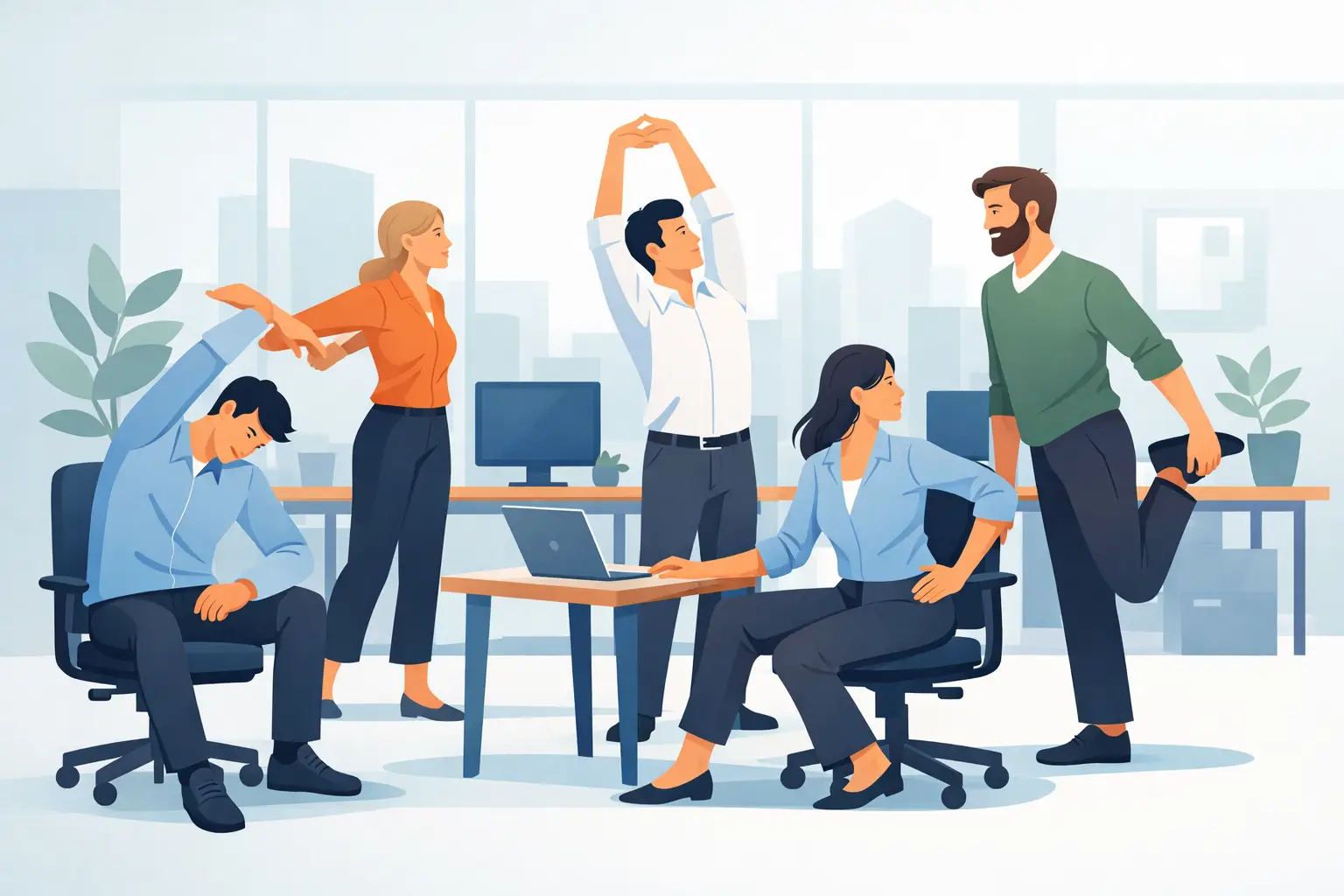
A diary full of video calls can leave employees with tight shoulders, tired eyes and a stiff lower back before lunchtime. The best desk stretching exercises give people a realistic way to interrupt that build-up without changing clothes, leaving the office or sacrificing a large part of the working day.
For employers, the objective is not to turn every desk into a gym. It is to make brief movement breaks normal, accessible and easy to repeat. Used well, desk stretches can support comfort, concentration and a workplace culture that treats employee wellbeing as a practical part of performance.
Why desk stretching belongs in a wellbeing programme
Desk-based work often involves prolonged sitting, limited changes of position and repeated use of a keyboard, mouse and mobile phone. Over time, employees may notice tension around the neck and shoulders, restricted movement through the upper back, tight hips or discomfort in the wrists and forearms.
A short stretch cannot correct every ergonomic issue or replace clinical care. However, regular movement helps employees break up static postures and notice where they are holding tension. It is most effective alongside sensible workstation set-up, appropriate screen height, supportive seating and a culture where people feel able to take a few minutes away from their tasks.
For HR and office managers, this is also a low-friction wellbeing habit. A two-minute prompt between meetings is easier to introduce than a programme that requires travel, equipment or a long time commitment. The trade-off is that self-led stretches depend on participation and good technique, so clear guidance matters.
10 best desk stretching exercises for office teams
Employees should move gently, breathe normally and stop if a stretch causes sharp pain, tingling, dizziness or worsening symptoms. Stretches should create mild tension, not force a joint beyond its comfortable range. Anyone with an injury, recent surgery or a medical condition should seek individual advice before taking part.
1. Neck side stretch
Sit tall with both feet supported on the floor. Let the shoulders drop away from the ears, then gently tilt the right ear towards the right shoulder without lifting the shoulder to meet it. Hold for 15 to 20 seconds, return to centre and repeat on the other side.
This can feel particularly useful after long periods on calls. The key is to avoid pulling the head down with a hand, which can turn a gentle release into an overly aggressive stretch.
2. Chin tuck
Looking straight ahead, gently draw the chin backwards as if making a double chin. Keep the head level rather than looking down. Hold for five seconds, release and repeat five to eight times.
This small movement can help counter the forward-head position that often develops when people lean towards a laptop screen. It should feel controlled, not strained through the throat or jaw.
3. Shoulder rolls
Lift both shoulders slowly towards the ears, roll them backwards and then let them settle down. Repeat eight to 10 times, then change direction if it feels comfortable.
Shoulder rolls are simple enough to use as a transition between tasks. They work best when employees take the movement slowly rather than rushing through it while reading another message.
4. Upper back reach
Interlace the fingers in front of the body with palms facing away. Gently reach the hands forwards at shoulder height and allow the upper back to round slightly. Hold for 15 seconds while keeping the shoulders relaxed.
This stretch targets the area between the shoulder blades, which can feel restricted after keyboard work. Employees should avoid holding their breath or shrugging their shoulders upwards.
5. Seated chest opener
Move towards the front of the chair and place both hands behind the lower back, or lightly hold the sides of the chair if that is more comfortable. Draw the shoulder blades gently together and lift through the chest without arching the lower back excessively. Hold for 15 to 20 seconds.
A chest opener offers a useful counter-movement to rounded shoulders. For employees with shoulder pain, a smaller movement is often the better option.
6. Seated spinal twist
Sit upright with feet flat. Place the right hand on the outside of the left thigh and use the left hand lightly on the chair for support. Turn the ribcage gently to the left, keeping the hips facing forwards. Hold for 15 seconds and repeat on the other side.
The movement should come from the upper body, not from forcing the neck around. This is a practical stretch after sitting in one position for a lengthy meeting.
7. Seated side reach
Raise the right arm overhead and lean gently to the left, keeping both sitting bones grounded on the chair. Hold for 15 seconds, then change sides.
The side reach creates length through the side body and can feel refreshing after a period of stillness. Employees should keep the movement modest if they have lower-back sensitivity.
8. Wrist flexor and extensor stretch
Extend one arm in front with the palm facing forwards. With the other hand, gently draw the fingers back towards the body for a light stretch through the forearm. Then turn the palm down and gently guide the fingers towards the body to stretch the top of the forearm. Hold each position for 10 to 15 seconds before changing sides.
This is one of the most relevant desk stretches for employees using a mouse or keyboard for much of the day. Numbness, persistent pain or weakness should not be treated as something to stretch through and may need professional assessment.
9. Seated figure-four hip stretch
Sit towards the front of a stable chair and place the right ankle on the left thigh, keeping the right foot flexed. Stay upright or hinge forwards slightly from the hips until a gentle stretch is felt around the right hip. Hold for 15 to 20 seconds, then swap sides.
Tight hips are common when sitting for long periods, but this position is not suitable for everybody. Employees with knee or hip concerns can skip it and choose a standing movement instead.
10. Standing calf stretch and reset
Stand behind the chair and hold the backrest lightly for balance. Step one foot behind, keep that heel down and bend the front knee until a stretch is felt in the rear calf. Hold for 15 to 20 seconds, then switch sides.
Finishing with a standing stretch encourages employees to leave the chair altogether. A short walk to refill a water bottle or speak to a colleague can extend the benefit by adding a change of environment as well as movement.
How to make desk stretches stick at work
The best results come from frequency, not a single ambitious session. Encourage teams to take one or two minutes between calls, after focused work blocks or at the start of a team meeting. A voluntary approach works better than policing participation, particularly in organisations with different roles, mobility levels and working patterns.
Managers can make the habit visible by joining in themselves. A brief stretch prompt at the beginning of a meeting signals that movement is accepted rather than seen as time away from work. For hybrid teams, include the same prompt in virtual meetings so home-based employees are not excluded.
It is also worth reviewing the source of recurring discomfort. If several employees report neck strain, for example, a stretch routine may help in the moment, but screen position, laptop use and workload patterns may need attention too. Desk stretching is a useful layer of prevention, not a substitute for ergonomic assessment or occupational health support.
When expert-led support adds more value
Self-guided stretching is a sensible starting point, but it has limits. Teams may benefit from qualified practitioners where stress, muscle tension and sedentary working are persistent concerns, or where an employer wants a wellbeing initiative with stronger engagement than a poster or reminder alone can provide.
Onsite chair massage and assisted stretching can give employees individual attention within a manageable workplace format. Practitioners can help people understand safe movement, release areas of tension and take a meaningful pause from the demands of the day. Therapy Bookings provides flexible workplace wellbeing services designed for offices across London and the UK, making it easier for employers to build support around their team, schedule and objectives.
A healthier workday rarely depends on one big intervention. It is built through small, credible signals that people are expected to work well, not simply work continuously. Start with a stretch break that fits the rhythm of your team, then give employees the practical support to make that pause count.