
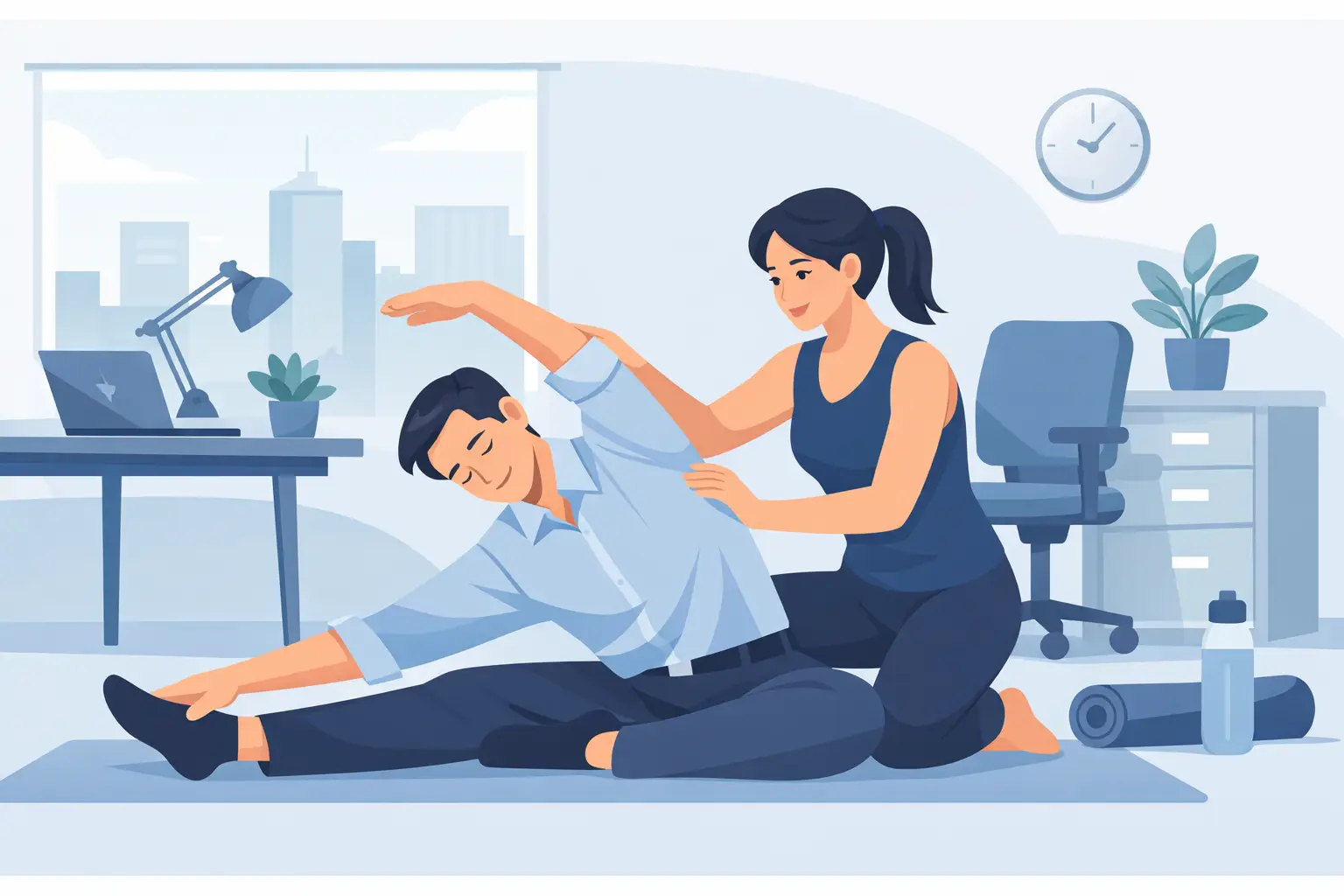
At 3pm, the issue is rarely a lack of commitment. It is the accumulated effect of hours spent at a screen: shoulders creeping upwards, hips stiffening in the chair, and concentration fading as discomfort becomes harder to ignore. For desk-based teams, assisted stretching for office workers is a practical way to interrupt that pattern without asking employees to leave the workplace or block out an hour of their day.
Delivered onsite by a qualified practitioner, a short assisted stretching session helps employees move through targeted stretches safely and comfortably. It is an accessible addition to an employee wellbeing programme because it is quick, fully managed and directly relevant to how most office teams work.
Why desk-based work creates physical strain
Office work may look low impact, but sustained sitting places the body under a particular kind of load. Employees often spend long periods with their head inclined towards a laptop, their arms held forward for typing and their hips fixed in one position. Even a well-designed workstation cannot remove the need for regular movement.
The result can be stiffness through the neck, shoulders, back and hips, alongside general fatigue. Stress can add to the picture. When workloads rise, people tend to take fewer movement breaks, breathe more shallowly and carry tension for longer. This does not mean every ache is caused by work, nor should workplace wellbeing services be presented as a substitute for medical assessment. It does mean employers have a sensible opportunity to help people reset during the working day.
A visible wellbeing provision also communicates something valuable: employee comfort is not an afterthought. For HR teams and office managers, that message can support a more considerate, engaged workplace culture.
What assisted stretching for office workers involves
Assisted stretching is a one-to-one session in which a trained practitioner guides an employee through controlled stretches. Rather than asking someone to guess their range of movement or force a position, the practitioner helps them find a comfortable stretch and adapt it to their mobility, posture and any relevant concerns.
Sessions are typically short, making them suitable for busy offices, away days and wellbeing events. Employees remain clothed and the service can be delivered in a suitable quiet area of the office. Depending on the format, the practitioner may use a chair, massage couch or clear floor space. The focus is often on areas affected by desk work, including the upper back, shoulders, chest, forearms, lower back, glutes and hip flexors.
The experience should feel supportive, not intense. Effective stretching does not require discomfort, and employees should always be encouraged to communicate what feels appropriate. A qualified therapist will screen for contraindications, adjust the session where needed and advise an employee not to participate if stretching is unsuitable on the day.
The business case goes beyond a pleasant break
Wellbeing initiatives are most effective when they fit real working patterns. A stretching service can be booked around meetings, delivered in manageable appointment slots and offered to teams without creating significant operational disruption. That simplicity matters when a programme is being organised by an already busy people or operations team.
For employees, the immediate value is often a sense of relief, movement and renewed energy. A brief pause away from the screen can help break the cycle of static posture and encourage more awareness of how the body feels during the day. For employers, the wider benefit is a workplace experience that feels purposeful rather than performative.
Assisted stretching can contribute to business goals in several connected ways. It can support morale by giving people time and permission to look after themselves. It can strengthen engagement by offering a benefit that is useful to a broad range of employees, not only those who already take part in fitness activities. It may also complement wider efforts to address stress, reduce absence risk and retain valued people.
The return is not best measured by claiming that one session will solve musculoskeletal problems or transform productivity. It is better assessed through participation, employee feedback, repeat demand and its place within a consistent wellbeing strategy. A service employees genuinely use is more valuable than a high-profile perk that goes untouched.
Where stretching fits in a workplace wellbeing programme
Assisted stretching works well as a standalone service, particularly for a wellbeing day, office move, team reward or period of high workload. It can also sit alongside chair massage, reflexology, hand massage, spinal analysis or nutrition consultations to create a more rounded programme.
The right combination depends on the workforce. A team with long hours at laptops may respond particularly well to chair massage and stretching. A large event with limited space may need shorter, high-throughput sessions. A smaller business may prefer a regular monthly service that employees can plan around. There is no universal package, which is why flexible scheduling and a clear understanding of the workplace are important.
Employers should also consider the practical environment. A private meeting room is ideal, but it is not always essential. What matters is enough room for the practitioner to work safely, a calm setting where employees feel at ease and a booking process that avoids queues or confusion. Experienced providers can advise on timings, space requirements and the number of therapists needed for the size of the team.
How to make an onsite stretching session successful
The quality of the service matters, but so does the way it is introduced. Position it as a useful working-day reset rather than a treat people need to earn. Senior leaders taking part can help remove any perception that employees should be too busy to step away from their desks.
Clear communications are equally important. Explain what the session involves, how long it takes, that employees stay clothed and how they can reserve a place. Some people may be unfamiliar with assisted stretching or unsure whether it is for them. A straightforward description helps make the service feel approachable.
To get the strongest uptake, plan around the working day. Avoid the busiest meeting windows where possible, offer enough appointments to make access fair and build in a little flexibility for last-minute changes. For hybrid teams, rotating service days or aligning visits with established office days can improve participation.
After the event, collect brief feedback. Ask whether employees found the session helpful, whether the timing worked and what they would like to see next. This gives decision-makers evidence for future wellbeing planning and helps refine a recurring programme.
What to look for in a provider
A workplace service should be easy to arrange, but it should never compromise on professional standards. Look for fully qualified, insured therapists with experience of working in corporate environments. They should be confident adapting sessions to different people, managing health considerations appropriately and creating a professional experience in a busy office setting.
Nationwide coverage can be particularly useful for organisations with teams in more than one location, while local knowledge and reliable logistics matter for regular London office services. Ask about scheduling support, therapist numbers, equipment, setup needs and how the provider handles employee confidentiality and consent.
Therapy Bookings brings more than 25 years of complementary healthcare expertise to onsite wellbeing, with qualified therapists and flexible programmes for businesses across London and the UK. The aim is to make employee support straightforward for employers while delivering an experience staff will value.
A practical next step for employers
If your team is regularly dealing with screen fatigue, tense shoulders and long periods of sitting, start small. A single onsite assisted stretching day can show what engagement looks like in your workplace, while a recurring programme can make movement and recovery part of the employee experience rather than an occasional gesture.
The most effective wellbeing support is not necessarily the most elaborate. It is the support that employees can use easily, trust and feel the benefit of during an ordinary working week.
Trackbacks/Pingbacks