
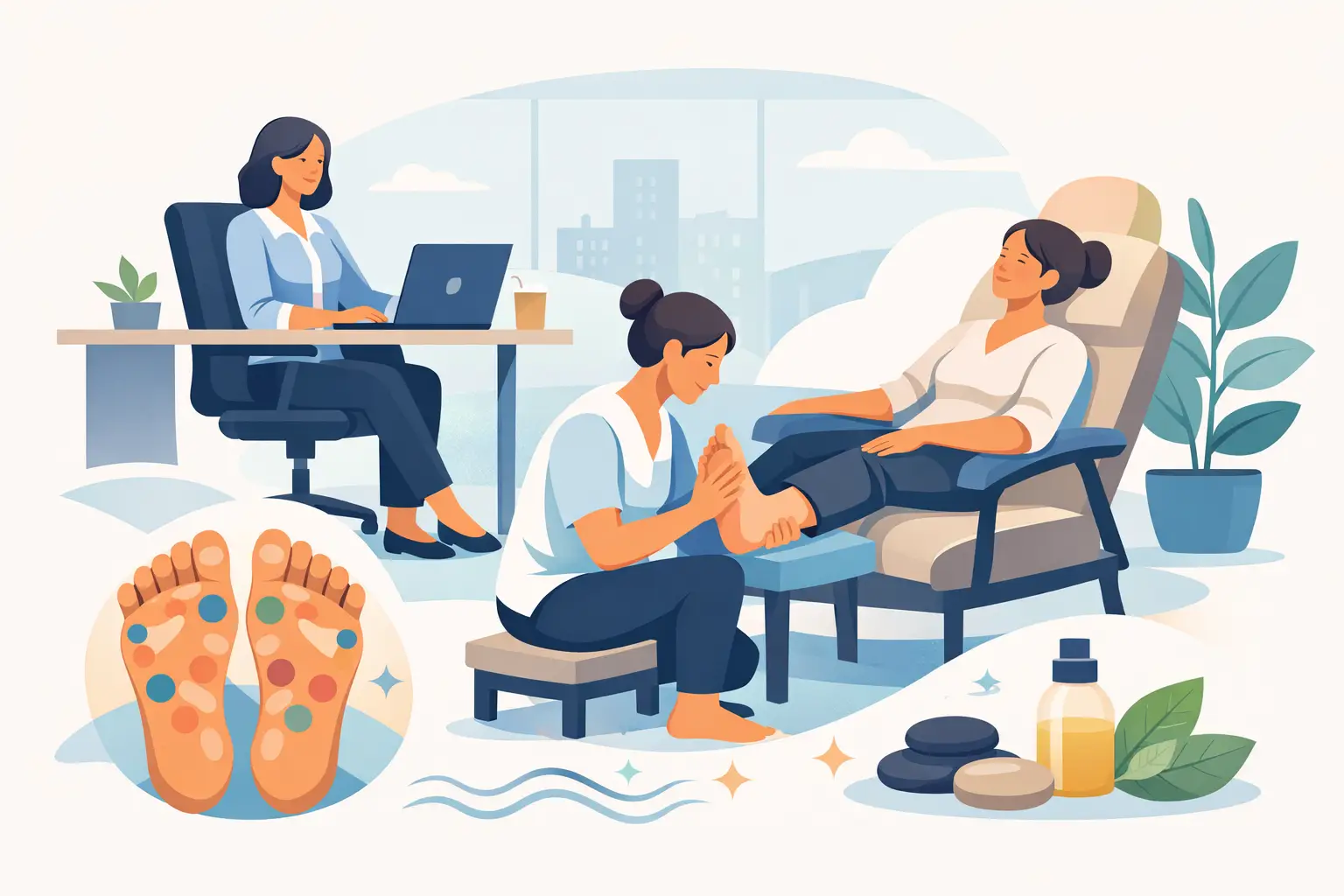
A diary packed with meetings, screens and deadlines leaves little room for employees to reset properly. Workplace reflexology sessions create that pause without asking people to travel, change clothes or give up a large part of their day. Delivered on-site by qualified practitioners, they are a practical way to show care while supporting a calmer, more engaged working environment.
For HR and office teams, the appeal is not simply that reflexology feels good. It is a flexible workplace wellbeing service that can be organised around the realities of a busy office, from a one-day wellbeing event to a recurring programme for hybrid teams. The right format makes participation easy, which is what turns a wellbeing initiative from a nice idea into something employees genuinely value.
What happens in a workplace reflexology session?
Reflexology is a complementary therapy involving pressure and massage techniques applied to specific points on the feet. In a workplace setting, sessions are usually delivered in a quiet meeting room or designated wellbeing area, with the employee seated comfortably in a portable therapy chair. There is no need for oils, changing facilities or a treatment table.
Most appointments last between 15 and 30 minutes. A shorter session works well when a large number of employees need to be seen during an event; a longer appointment gives the therapist more time to tailor the treatment to the individual’s comfort and priorities. Employees remove their shoes and socks, then remain fully clothed throughout.
A professional therapist begins by checking relevant health information and explaining what to expect. The treatment itself should feel calming, although pressure can be adjusted. Reflexology is not a medical treatment, diagnosis or replacement for clinical care. It is best positioned as supportive wellbeing provision for employees who want a restorative break in their working day.
Why workplace reflexology sessions suit desk-based teams
Desk-based work can be mentally demanding even when it is physically sedentary. Long periods of concentration, back-to-back video calls, digital fatigue and limited movement can leave people feeling tense and depleted by mid-afternoon. A focused treatment away from the desk gives employees permission to stop, breathe and return with a clearer head.
The immediate value is often personal: people report feeling more relaxed, looked after and able to reset. For employers, those individual moments can support broader goals around morale, engagement and workplace culture. When wellbeing is convenient and inclusive, it sends a more credible message than a benefit employees must find time to use outside work.
Reflexology can also be a strong alternative for employees who do not want a chair massage or who prefer not to have work carried out on their back, shoulders or neck. Offering a choice helps make a wellbeing day feel more considered. It recognises that different people respond to different types of support.
That said, reflexology will not be the right preference for everyone. Some employees may be uncomfortable with foot-based treatments, while others may want support more directly related to postural tension. A mixed programme combining reflexology with chair massage, hand massage or assisted stretching can improve participation across a diverse team.
The business case goes beyond a one-off perk
Employee wellbeing is most useful when it supports the conditions in which people can do good work. A well-run on-site therapy day can provide a visible lift in atmosphere, create positive conversation and give managers a simple way to recognise sustained effort during a demanding period.
For organisations managing change, growth or high workloads, the timing can be particularly valuable. Workplace reflexology sessions can complement initiatives around Mental Health Awareness Week, a return-to-office plan, an employee appreciation event or a regular wellbeing calendar. They are not a cure for workload problems or poor management practices, but they can be one meaningful part of a wider approach to employee experience.
The commercial benefit is in making care tangible. Retention, discretionary effort and engagement are influenced by many factors, including pay, leadership and career development. A therapy session cannot replace those fundamentals. However, consistent, practical wellbeing support can reinforce a culture in which employees feel noticed rather than treated as an afterthought.
How to organise reflexology without creating more work
Operational ease matters. HR leaders and office managers should not have to spend days coordinating a wellbeing benefit. Start with the number of employees likely to attend, the available time window and whether the aim is a high-volume event or a smaller, more personalised experience.
A single qualified reflexologist can generally see several employees over a working day, depending on appointment length and breaks. Fifteen-minute slots are effective for a busy office because they keep the schedule moving and reduce time away from work. For senior leadership days, smaller teams or ongoing wellbeing programmes, 20 to 30 minutes may be the better fit.
A suitable room needs privacy, enough space for a therapy chair and a calm atmosphere away from constant interruptions. It does not need to be elaborate. A small meeting room with a door, reasonable ventilation and access to handwashing facilities is usually sufficient. Clear signage and an appointment schedule help employees arrive on time and protect the relaxed nature of the session.
It is also worth deciding how bookings will work before announcing the event. Pre-booked slots reduce no-shows and give employees certainty, while a short waiting list helps fill cancellations. For drop-in events, position the therapy area somewhere visible enough to encourage interest, but private enough for people to feel comfortable taking part.
Choose practitioners and providers carefully
The quality of delivery shapes the employee experience. Qualified and insured practitioners should carry out appropriate consultations, observe professional boundaries and adapt pressure to the individual. They should also understand when a treatment needs to be postponed or modified due to a health concern.
For employers with multiple offices or a distributed workforce, provider coverage matters too. Therapy Bookings works with fully qualified therapists across London and the UK, making it easier to deliver a consistent service across one-off events and ongoing workplace programmes.
Making participation inclusive
The most successful wellbeing services are designed for real working patterns, not an idealised office day. Offer sessions across a broad time range so parents, part-time colleagues, customer-facing teams and employees with fixed meetings have a fair chance to take part. Avoid making attendance feel like a reward reserved for one department or seniority level.
Communications should be simple and specific. Explain that the session is fully clothed, how long it lasts and what employees need to do beforehand. Mention that they can speak to the therapist about comfort or any relevant health considerations. This removes uncertainty, particularly for colleagues who have never tried reflexology.
Accessibility also means avoiding exaggerated promises. Position the service as an opportunity to relax and recharge, not as a treatment that will solve a medical condition. That honest framing builds trust and ensures employees can make an informed choice.
How to measure whether the programme is worthwhile
Not every wellbeing activity needs a complex dashboard, but organisations should know whether employees found it useful. A short anonymous feedback form sent immediately after the event can capture satisfaction, perceived stress relief, likelihood of attending again and comments on the booking process.
For a recurring programme, track appointment uptake, repeat participation and no-show rates alongside qualitative feedback. These measures reveal whether the format is accessible and whether session lengths, days or locations need adjusting. High demand may justify additional therapist hours; low uptake may signal that the timing or internal communication needs attention rather than that the service lacks value.
The most useful question is often straightforward: did this make employees feel supported in a way they could actually access? If the answer is yes, reflexology has done more than fill a wellbeing calendar. It has created a small but meaningful point of care in the working week.