A tense team rarely announces itself in a staff survey first. It shows up in shortened tempers, afternoon fatigue, recurring neck and shoulder complaints, and people working through breaks because they feel they cannot step away. This onsite chair massage guide explains how employers can introduce a practical wellbeing service that gives desk-based teams genuine relief without disrupting the working day.
Chair massage is not a decorative office perk. When planned well, it is a visible, easy-to-use intervention that supports morale, encourages people to take a proper pause and reinforces that employee wellbeing is taken seriously. For HR teams and office managers, its value lies in the balance: a short session can feel personally meaningful to an employee while remaining straightforward to organise at scale.
What onsite chair massage involves
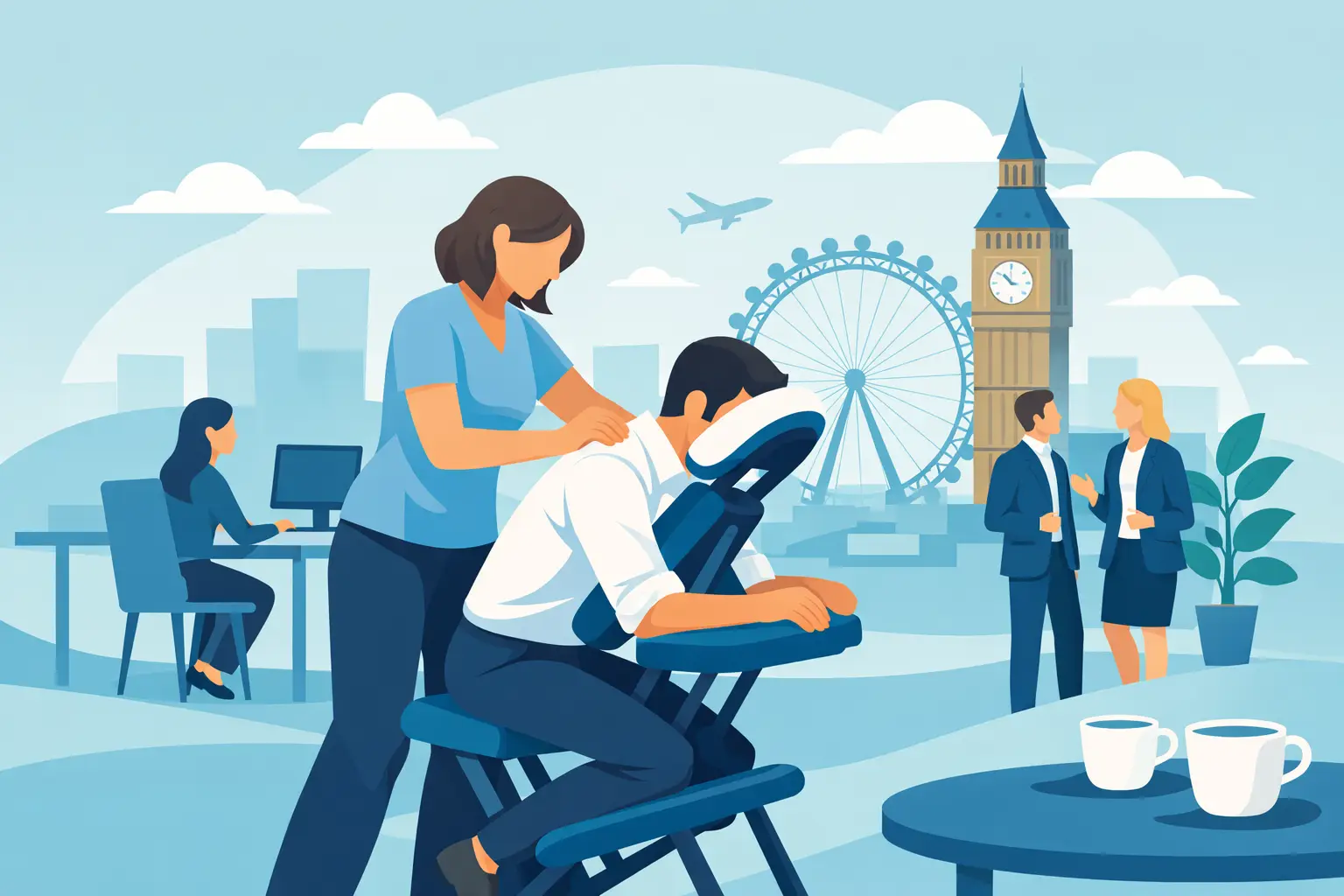
Onsite chair massage is delivered in a specially designed ergonomic chair, with the employee fully clothed. A qualified therapist works mainly on the upper back, shoulders, neck, arms, hands and scalp – the areas most commonly affected by desk work, screen time and repetitive movement.
Sessions are usually 10, 15 or 20 minutes. The right length depends on your objectives, team size and available time. Ten-minute appointments work well for large events and busy offices; 15 to 20 minutes allow more time for tailored attention and are often better suited to smaller teams or recurring wellbeing programmes.
No oils, changing facilities or treatment room are normally required. The therapist brings the chair and essential equipment, so a quiet meeting room, unused corner or screened-off area is generally enough. This low set-up requirement is one reason chair massage works particularly well for offices, co-working spaces, staff appreciation days and wellbeing events.
Why chair massage makes business sense
Employers are under pressure to improve engagement while managing budgets, hybrid working patterns and competing operational priorities. The most effective wellbeing activity is not necessarily the most elaborate. It is the one employees will actually use and remember.
Chair massage has a low barrier to participation. Employees do not need to change clothes, commit an hour of their day or know anything about complementary therapies. They can step away from their desk, receive a focused treatment and return feeling acknowledged and more comfortable.
That experience can support several workplace goals. It can help relieve feelings of muscular tension, create a calmer atmosphere during demanding periods and give managers a practical way to recognise their people. It also provides a useful conversation starter around posture, breaks and sustainable working habits.
The commercial benefit is cumulative rather than instant. A single event can lift morale and add energy to an internal campaign. Regular sessions can become part of a broader approach to reducing stress, supporting retention and making the workplace a more attractive place to work. Chair massage should not be presented as a cure for workload problems or poor management, but it can be a credible part of a wider employee wellbeing plan.
Planning an onsite chair massage session
The strongest programmes are designed around how your organisation actually operates, not around a one-size-fits-all package. Before booking, decide whether the priority is employee appreciation, stress support, a wellbeing event, return-to-office engagement or an ongoing benefit.
Match capacity to your team size
Start with the number of employees likely to participate, rather than total headcount. A 10-minute session allows one therapist to see roughly five people per hour once brief changeovers are included. For a 15-minute session, allow closer to three or four people per hour.
If you have a team of 80 and want everyone to have an opportunity, one therapist for a short afternoon will not be enough. You may need multiple therapists, a longer booking window or a system that prioritises volunteers. Getting this calculation right protects the employee experience and avoids disappointment on the day.
Choose the right appointment system
Pre-booked time slots are usually best for structured offices, client-facing teams and larger organisations. They reduce queues, help managers maintain cover and allow employees to plan around meetings. A simple booking sheet with clear instructions is often all that is needed.
Drop-in sessions can work well for open days, exhibitions and informal staff events, where flexibility matters more than guaranteed access. They feel relaxed, but there is a trade-off: popular sessions may create a queue, and quieter employees may miss out. For mixed workforces, reserve some slots in advance and keep a small number for walk-ins.
Select a suitable space
The room does not need to be large, but it should offer privacy, reasonable ventilation and a calm environment. Avoid placing the chair beside a busy kitchen, reception desk or noisy bank of hot desks if possible. Employees are more likely to relax when they do not feel observed or rushed.
Think about access as well. The space should be easy to find, suitable for the therapist’s equipment and available for the full session, including set-up and packing away. If your workforce is spread across floors or sites, rotating locations or providing several therapists may improve participation.
How to encourage uptake without creating pressure
The invitation matters. Position chair massage as an optional opportunity to reset, rather than a treatment employees are expected to accept. Use clear, practical language: explain the session length, confirm that staff remain clothed and state where it will take place.
A short message from a senior leader or people manager can strengthen uptake because it signals permission to take the time. This is particularly valuable in cultures where employees worry that stepping away from their desk may be judged negatively.
Accessibility and inclusion should be considered from the outset. Offer appointments at different times where shifts, caring responsibilities or customer-facing duties affect availability. Ask employees to speak confidentially with the organiser or therapist if they need reasonable adjustments. People should never feel obliged to disclose personal health information to take part or decline.
Safety, professionalism and therapist standards
Workplace wellbeing should feel easy for the employer, but it must be delivered responsibly. Use fully qualified and insured therapists with relevant chair massage experience. Professional therapists will conduct a brief consultation before treatment, ask appropriate health questions and adapt or decline treatment where it is not suitable.
Employees with certain conditions, recent injuries, pregnancy-related considerations or acute symptoms may need a modified session or advice to seek medical guidance. Chair massage is complementary wellbeing support, not a substitute for clinical assessment or treatment. Clear boundaries protect employees, therapists and the business.
Good providers also understand workplace conduct. They arrive on time, present professionally, protect confidentiality and manage appointments efficiently. For employers, this operational reliability is as important as the treatment itself. A wellbeing event that runs late, lacks privacy or creates confusion can undermine an otherwise positive initiative.
Measuring the value of chair massage
You do not need a complex dashboard to understand whether a session worked. Start with the measures that reflect your original aim. For a one-off appreciation event, participation rate and short feedback comments may be enough. For a recurring programme, track uptake by site or department, repeat participation and sentiment over several months.
Ask employees a few focused questions after the session: did they find it helpful, did the appointment length work, and would they use the service again? Keep the survey brief and anonymous where possible. Qualitative comments often reveal practical improvements, such as a need for earlier appointments, more privacy or longer sessions.
Avoid overstating what any single wellbeing service can deliver. Lower absenteeism and improved retention are long-term organisational outcomes influenced by many factors. The more credible approach is to show how chair massage contributes to a broader employee experience strategy alongside workload management, supportive leadership, flexible working and access to appropriate health support.
When chair massage is the right choice
Chair massage is especially effective when you need a high-impact activity in a limited space and time frame. It suits teams affected by prolonged sitting, intensive screen work or periods of high workload. It is also a strong choice for recruitment events, office moves, company milestones and return-to-office initiatives because the benefit is immediate and easy to understand.
It may not be the complete answer for every objective. If your team wants deeper relaxation, a more private treatment environment or targeted musculoskeletal support, longer-format therapies or an assisted stretching programme may be more appropriate. Some employers achieve the best participation by offering chair massage alongside options such as reflexology, hand massage, spinal analysis or nutrition consultations.
Therapy Bookings can help employers shape a programme around workforce size, location, schedule and wellbeing priorities, whether the requirement is a one-off London event or a recurring service across UK sites.
The most useful next step is simple: look at the point in your employee calendar where pressure is highest or appreciation would mean most, then create enough protected time for people to take part. When a wellbeing initiative is easy to access and thoughtfully delivered, employees do not just see the massage chair – they see evidence that their time, comfort and contribution matter.