
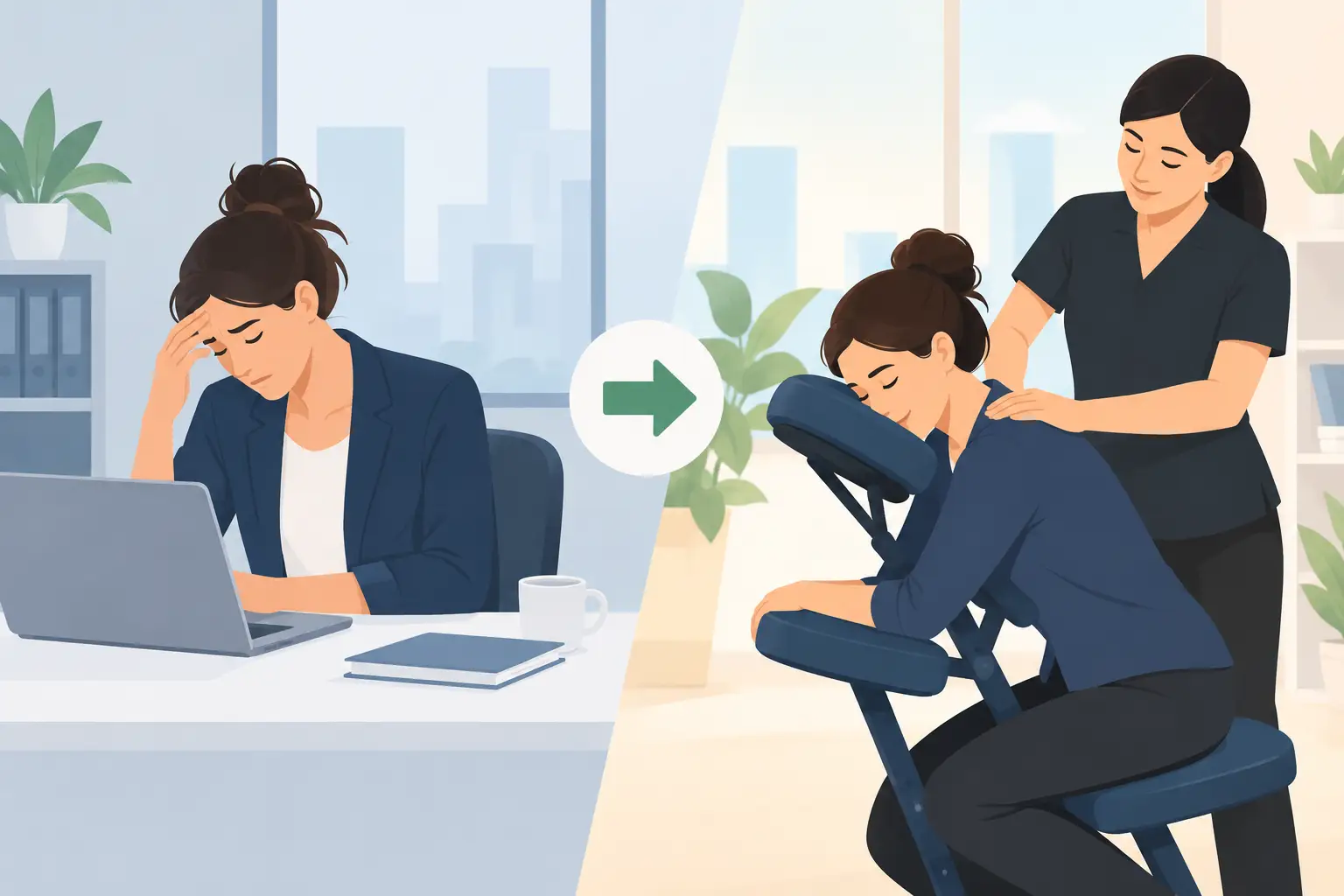
At 2.30pm on a busy Thursday, a London-based team was still working through a demanding client deadline. The office was quiet, but not because everyone was focused. Shoulders were tight, people were rubbing their necks between calls, and several employees had postponed lunch. This workplace massage case study shows what can happen when an employer responds to that familiar pressure with a practical, well-managed wellbeing intervention rather than another generic perk.
The example below is an anonymised, illustrative composite based on common workplace needs seen in desk-based teams. It is not a promise of identical results. Every organisation has different pressures, attendance patterns and workplace culture. What it does demonstrate is how chair massage can be planned, measured and used to support wider people objectives.
The business challenge
The business was a growing professional services firm with around 70 employees split between a London office and hybrid workers. Its people team had identified a recurring issue: staff were committed and capable, but periods of high workload were followed by visible fatigue, lower energy and comments about neck, shoulder and back discomfort.
The company already offered flexible working and an employee assistance programme. Those benefits mattered, but they were not always visible in the working week. The HR lead wanted an onsite initiative that employees could use immediately, without taking a lengthy appointment or travelling elsewhere.
There was also a commercial consideration. The organisation was preparing for its annual engagement survey and wanted to show that employee feedback led to tangible action. The brief was clear: the service needed to be easy to organise, suitable for a busy office and credible enough to support an ongoing wellbeing programme if uptake was strong.
Workplace massage case study: the programme design
The employer chose onsite chair massage because it could be delivered in a small meeting room and did not require employees to change clothes or use oils. Sessions were set at 15 minutes, allowing people to book around meetings while giving the therapist enough time to focus on common areas of tension, particularly the upper back, shoulders, neck, arms and hands.
The initial programme ran as a monthly trial across three months. Rather than offering first-come, first-served slots alone, the people team used a simple booking schedule with a small number of spaces held back for staff who had limited diary control, including client-facing and support colleagues. This helped make access feel fairer and reduced last-minute disruption.
Therapy Bookings supplied qualified, insured practitioners and worked with the office manager on the practical details: arrival times, room set-up, booking capacity and employee communications. A quiet, private space with enough room for a massage chair was sufficient. The employer did not need to purchase equipment or train internal staff to run the service.
This operational simplicity was central to the decision. A wellbeing initiative can lose momentum quickly if it creates another administrative task for HR or facilities teams. In this case, the programme had a named coordinator, a clear schedule and a consistent format, so employees knew what to expect each month.
Setting expectations properly
The communication did not present massage as a medical treatment or a cure for workplace stress. Instead, it positioned the sessions as short, professional support for comfort, relaxation and a reset during demanding days. Employees were advised to share relevant preferences with the therapist and to seek appropriate clinical advice for ongoing pain or health concerns.
That distinction matters. Chair massage can be a valuable part of an employee wellbeing offer, but it should sit alongside sensible workstation assessments, workload management, flexible working practices and access to appropriate support. It is not a substitute for addressing the underlying causes of excessive pressure.
What employees experienced
Take-up was strongest in the first month among staff who spent long periods at screens or in back-to-back meetings. Some booked because of shoulder tension; others simply wanted a protected pause in the working day. By the second session, employees who had initially been unsure were asking how to join the next booking list.
The immediate benefit most often described was not dramatic. It was practical: people felt less physically tense, calmer and better able to return to their work. For an employer, this is significant. The value of a short intervention is often in helping employees interrupt the cycle of sitting, rushing and carrying tension from one task to the next.
The service also created a useful point of connection. Employees spoke positively about the organisation making time for wellbeing during working hours, rather than expecting them to manage it entirely in their own time. That visible care helped reinforce the company’s wider message that performance and wellbeing should not be treated as opposing priorities.
How the employer measured value
A workplace wellness service should not be judged by enthusiasm alone. The HR lead tracked participation, repeat bookings and short anonymous feedback after each session. They also reviewed comments alongside existing engagement and absence data, taking care not to claim that one service alone caused changes in those broader measures.
The most useful questions were straightforward. Did employees find the session worthwhile? Did it help them feel more comfortable or relaxed? Would they use it again? Did the booking process work for different teams and working patterns?
Over the trial, the organisation looked for four practical signals:
- utilisation of available appointments, including whether slots were filled consistently;
- repeat participation, which indicated whether the experience met employee expectations;
- qualitative feedback on stress, comfort, morale and ease of access; and
- operational impact, such as whether the programme was simple for the office team to manage.
This approach gave the employer a more balanced picture than a single satisfaction score. High demand can be positive, but it may also mean the programme needs more capacity. Lower uptake is not always a sign that employees do not value wellbeing; it may point to unclear communication, inconvenient session times or a workplace culture where people feel unable to step away from their desks.
The trade-offs behind a successful rollout
The monthly format worked well for this office, but it will not suit every business. A smaller company may get better value from a one-off wellbeing day around a peak period, team event or return-to-office initiative. A larger employer may need multiple therapists, floor-by-floor scheduling or sessions across several sites.
Time allocation is another decision. Fifteen-minute chair massage sessions are accessible and efficient, particularly for a large team. Twenty or thirty minutes can provide a more personalised experience but reduces the number of employees seen in a day. The right balance depends on headcount, budget, available space and the outcome the employer wants to prioritise.
Hybrid working also needs thought. Onsite chair massage naturally benefits those attending the workplace, which can create a perceived gap for remote colleagues. Some employers address this by rotating office days, pairing massage with virtual wellbeing support, or alternating onsite services with initiatives that everyone can access. The point is not to make every benefit identical, but to make the overall offer feel considered and equitable.
What changed after the trial
At the end of three months, the people team did not claim that chair massage had solved workload pressure or transformed absence levels overnight. That would not be credible. What had changed was more immediate and measurable: the programme achieved consistent interest, generated positive employee feedback and gave the business a reliable wellbeing activity that staff could actually use during work.
The employer decided to continue with regular sessions during busier periods and use attendance and feedback to adjust capacity. It also used the comments received to revisit desk set-up guidance and remind managers to protect breaks during intensive project work. In other words, massage became one useful source of insight, not an isolated perk.
For HR leaders and office managers, that is the real lesson. The strongest workplace wellbeing programmes are simple enough to run, credible enough for employees to trust and flexible enough to evolve with the organisation. Start with a clear purpose, make access easy, ask employees what helped, and let their experience guide the next step.